How Nestlé Japan Implemented TOLFA
Nestlé Japan Ltd.
We spoke with Mr. Miyoshi, Manager of the Strategic Operation Planning Unit in the Consumer Relations Department, Marketing & Communications Division at Nestlé Japan Ltd., about their experience with TOLFA and the journey leading up to its implementation. In this interview, we explore how TOLFA was adopted to connect browser-based calls to their existing telephony infrastructure.
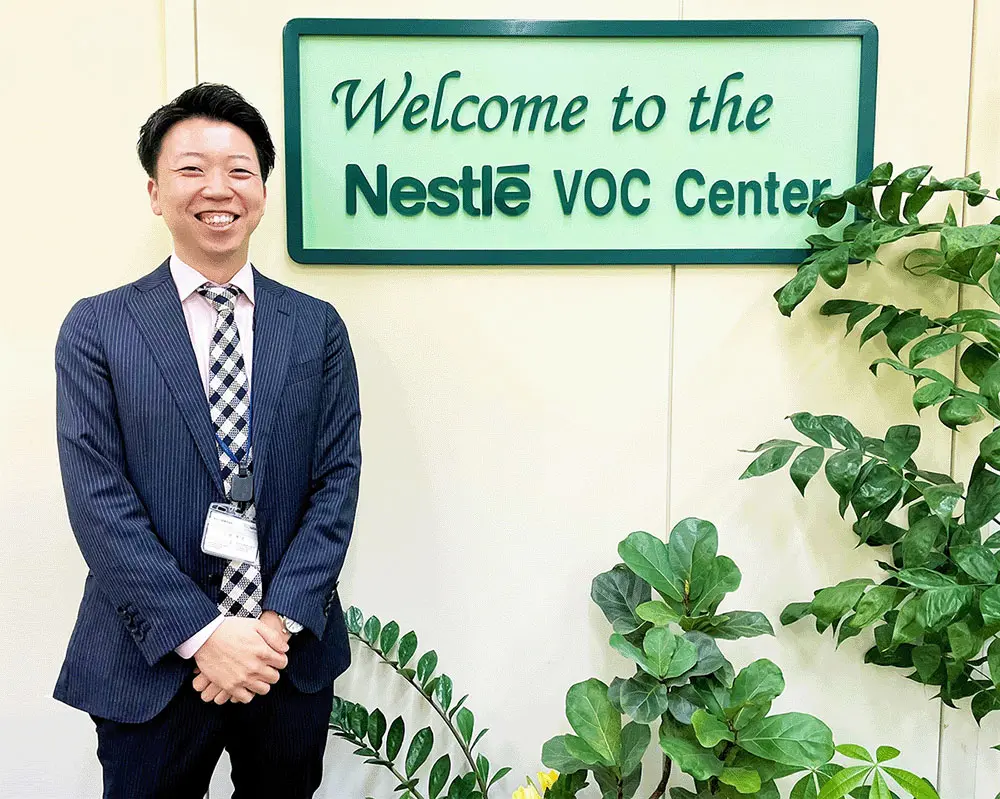
Mr. Miyoshi, Nestlé Japan Ltd.
A.U
Thank you very much for taking the time to speak with us today. We appreciate it.


Mr. Miyoshi of Nestlé Japan (titles omitted hereafter)
Thank you for having me.
A.U
To start, I’d like to ask about Nestlé Japan’s call center operations. How are they currently structured?
Miyoshi
We operate a company-managed call center at our headquarters as the core, supported by partner locations both in Japan and overseas. In total, we run several hundred seats, operating 365 days a year. We provide multiple support desks, including support for coffee machines such as Nescafé Barista and Nescafé Dolce Gusto, the Nestlé online shop call center, the Nestlé Customer Care Center, and the Nestlé Relationship Center for members.
A.U
I believe you also offer support through channels other than phone calls, correct?
Miyoshi
Yes. In addition to traditional email support, we provide AI-powered chat support through the Nestlé Chat Assistant, active support on Twitter, and—currently for limited inquiry types—automated voice response available 24 hours a day. We support customers through multiple channels.
A.U
I’ve heard that you consolidated your PBX systems across multiple locations.
Miyoshi
That’s correct. Previously, each call center location had its own PBX, and operations were handled separately. To centralize data management and improve efficiency, we consolidated them into our corporate PBX over several years. Even though locations are geographically distributed, we now operate as a single virtual call center, which has significantly improved operational efficiency.
A.U
It sounds like a very large-scale integration. What led you to make that decision?
Miyoshi
The primary reason was the lack of visibility into operations at each location. When running multiple sites, it’s difficult to monitor operations remotely. In addition, improving data management and reporting efficiency was a major factor. With separate PBXs, data was scattered across locations, making management extremely challenging. Collecting and consolidating data from all sites required a tremendous amount of effort. After consolidation, we can centrally access and manage all data, which has also strengthened governance of our call center operations.
A.U
With multiple PBXs, it seems like there could also be inconsistencies in the data collected.
Miyoshi
Exactly. Small discrepancies could occur, and correcting them required additional manual work. From an efficiency standpoint as well, consolidating the PBX systems was the right decision.
A.U
This time, you decided to introduce TOLFA. What motivated that decision?
Miyoshi
There were two key reasons. One was reducing communication costs, and the other was improving the customer experience, or CX.
A.U
Improving CX was a theme from the beginning. How do you approach that?
Miyoshi
We believe that guiding customers to the most appropriate contact channel when they reach out to us is critical to improving CX.
A.U
Could you elaborate on that?
Miyoshi
Customer inquiries vary widely, and customers themselves have different needs and attributes. As a result, the best channel depends on the situation. Some issues can be resolved through FAQs on our website, others through email or chat, and some are best handled by phone. Having multiple channels and allowing customers to choose is now standard, but we believe it’s essential for companies to proactively recommend and guide customers to the most suitable channel to maximize CX.
A.U
So, for example, when a customer enters keywords on the website and sees possible solutions?
Miyoshi
Yes, that’s the idea.
A.U
Being guided to a solution right away certainly reduces frustration. Sometimes issues don’t get resolved, which can be disappointing.
Miyoshi
That’s why it’s also important to design the next steps for customers if their issue isn’t resolved. By the way, is there anything TOLFA could help with in that area?
A.U
I’m not sure how far we could go, but perhaps customers could say a few keywords out loud, receive guidance by voice or text, or be directed to the appropriate URL. Just an idea off the top of my head.
Miyoshi
I see. So technically, it’s possible to use TOLFA as the starting point.
A.U
We don’t know yet whether this directly improves CX, but TOLFA allows customers to connect to the call center with a single action. What do you think about that?
Miyoshi
It’s easy to implement on web pages such as the Nestlé online store or even on portal sites. It could also be useful when a human agent is needed during AI chat interactions. We’re also considering broader use, including embedding QR codes on purchase receipts. The fact that customers don’t need to install an app on their smartphone or PC is a major advantage.
A.U
Thank you. If customers were required to install an app just to make an inquiry, many probably wouldn’t bother.
Miyoshi
The audio quality is better than I expected, isn’t it?
A.U
I feel that modern IP telephony offers audio quality comparable to traditional phone lines except for latency, but TOLFA feels even clearer than typical IP calls—though that may just be my impression.
Miyoshi
Since it’s browser-based rather than a traditional phone call, we initially had concerns about audio quality. However, being able to test it in advance and confirm the quality ourselves was reassuring.
A.U
From the call center perspective, since TOLFA isn’t a phone call, the caller’s phone number isn’t displayed in CTI and instead appears as “TOLFA NUMBER.” Do you see any inconvenience or concerns with that?
Miyoshi
In call centers, when identity verification is required, we usually ask customers to provide their phone number again. Customers don’t always call from a registered number, so we never rely solely on the number displayed in CTI to proceed. Even when customer information is automatically displayed, agents often search and confirm it manually. So we don’t see this as a major issue. How about other companies?
A.U
It hasn’t been a major issue. We’ve heard comments like “It’s good that it’s not the customer’s phone number,” “We don’t use CTI integration anyway,” and “Customers may feel more comfortable reaching out.” Some customers prefer not to share their phone number with call centers. If phone number verification is needed, SMS can be used, so we don’t see it as a problem. How about the other key point—cost reduction?
Miyoshi
Nestlé’s call centers incur significant communication costs every year. Reducing those costs alone is welcome, but when we consider improvements in CX, we expect even greater value. Based on the initial results, we’d like to expand our use of TOLFA going forward.
A.U
That would be wonderful. We also hope to expand beyond Japan in the future.
Miyoshi
This can be used from overseas as well, right?
A.U
Yes. As long as there’s an internet connection, it can be used from anywhere, even as an alternative to international calls. It can also be used in emergencies, provided there’s internet access. Network congestion may slightly affect audio quality.
Miyoshi
There’s one more important point. A major reason we chose TOLFA was that we could continue using our existing PBX. We had received many proposals for browser-based free calling services before, but all of them required adding a new PBX environment, which meant significant changes. That made adoption very difficult. When we learned about TOLFA and heard that we could continue using our existing PBX, handling both traditional phone calls and TOLFA calls on the same system, we immediately felt, “This is it.” For agents who interact directly with customers, being able to adopt the service without changing their working environment is extremely important. Reporting workflows also remain unchanged. This significantly lowered the adoption barrier and was the deciding factor for us.
A.U
TOLFA can connect to telephony systems such as AVAYA, NEC, OKI, Fujitsu, and Asterisk, whether cloud-based or on-premises. Do you have any requests for TOLFA going forward?
Miyoshi
We hope it will continue to deliver even greater improvements in customer experience.
A.U
Understood. While we can’t share details yet, we’re preparing our next service and would love the opportunity to present it to you.
Miyoshi
I’m looking forward to it. Once it’s ready, please be sure to show us. We’d love to be among the first to adopt it, just like TOLFA.
A.U
Thank you very much. Hearing that from Nestlé means a great deal to us. We’ll be sure to visit Sannomiya again to present the new service first. Thank you again for your time today, and we look forward to continuing our partnership.
Miyoshi
Likewise. Thank you.